
A first release
One workflow, one group of users, and a version small enough to try. Best when the operation is understood but the software does not exist yet.
Software engineering partner
We partner with ambitious businesses to design, develop, and scale innovative software solutions. The useful version of that is specific: a first release your staff can try, the code in your accounts, and a written scope before the build grows.
Services
Eight ways we help, from the first version of a product to the years after it ships.
Systems designed around a specific operation, when a packaged tool would bend the business out of shape.
Learn moreBrowser-based products for customers, partners, and the teams who serve them.
Learn moreiOS and Android applications for work that happens away from a desk.
Learn moreClear flows and interfaces for software people rely on every day.
Learn moreReliable connections between your product, your data, and the services you already use.
Learn moreEnvironments that are repeatable to deploy and calm to operate.
Learn morePractical automation for repetitive work, with a person still accountable for the result.
Learn moreFixes, updates, and steady care after the launch date has passed.
Learn moreWhat you actually get
How the work begins
Week 1. Map the work and what must not break.
Week 2. A written first release and a stack.
Weeks 3–4. Software in staging, on a real task.
Technology expertise
These are technologies we use in client work. A project gets the stack that fits the problem and the team that will live with it.
A sensible starting point
You do not need a full product plan to write to us. Tell us which of these is closest, and what “good” looks like for the people using it.
One workflow, one group of users, and a version small enough to try. Best when the operation is understood but the software does not exist yet.
Design and engineering on a system that has users. We start from the tasks people struggle with, then the next release, not a rewrite for its own sake.
An API or a connection between tools you already pay for. We design the contract, the failures, and how you will know when a sync stops.
Fixes, small improvements, and dependency updates for software that has to keep running. We agree what is covered before the first urgent ticket.
Why choose us
You work with the people designing and building the software, not a rotating account layer.
Goals, boundaries, and changes are recorded, so the project does not live only in a chat thread.
You receive the code, the documentation, and the access required to run what we build.
If a smaller change or an existing tool is the better answer, we will say so.
Featured projects
A few of the product types we design and build. Open a project for the industry, the technologies, and the capabilities inside it.
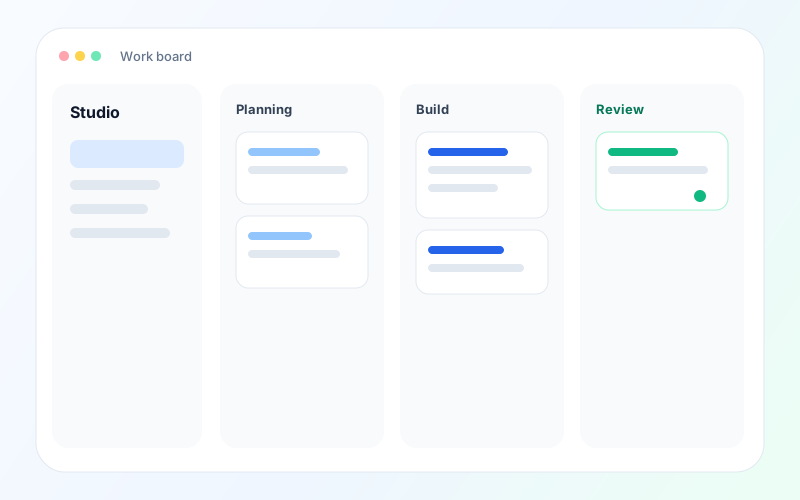
Professional services
A web application for coordinating client work across teams, with assignments and review status in one place.
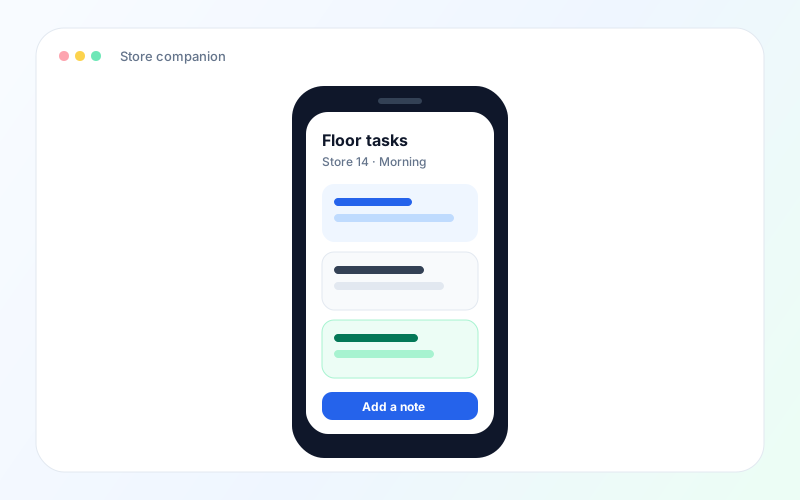
Retail
A mobile app for checking a task list, capturing a note, and keeping a shift moving without a back-office desktop.
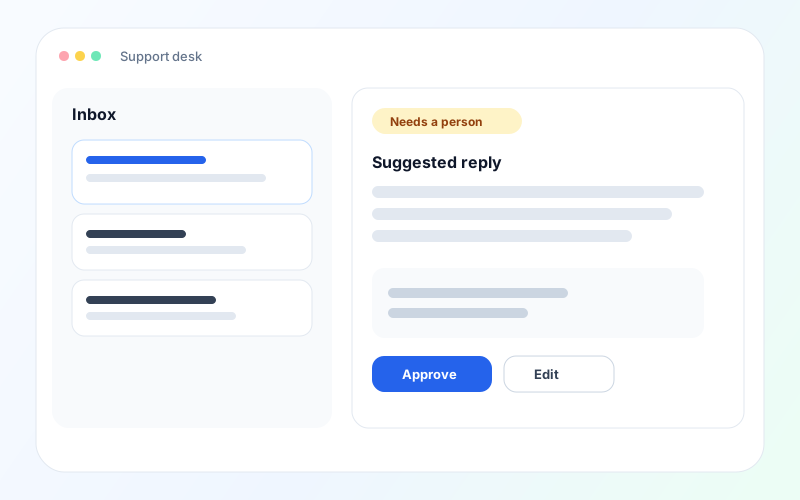
Software
An assistant that sorts incoming mail and drafts a reply for a person to edit. It does not send mail on its own.
Development process
We learn how the work happens today, who it is for, and what must not break.
We write a scope, the risks we can see, and a first release worth showing to users.
We shape the flows and the technical approach, and check them against real tasks.
We deliver in short cycles. You see working software while the context is still fresh.
We release, hand the system over, and stay for maintenance when you want us to.
Testimonials
The first release was small enough to try with one team, and sturdy enough that we kept building on it.
We always knew what was in scope. When something changed, it was written down before it was built.
The screen matched the way the day actually runs. People needed less help to get through it.
Share a short brief. We will reply with a practical view of scope, approach, and timing.